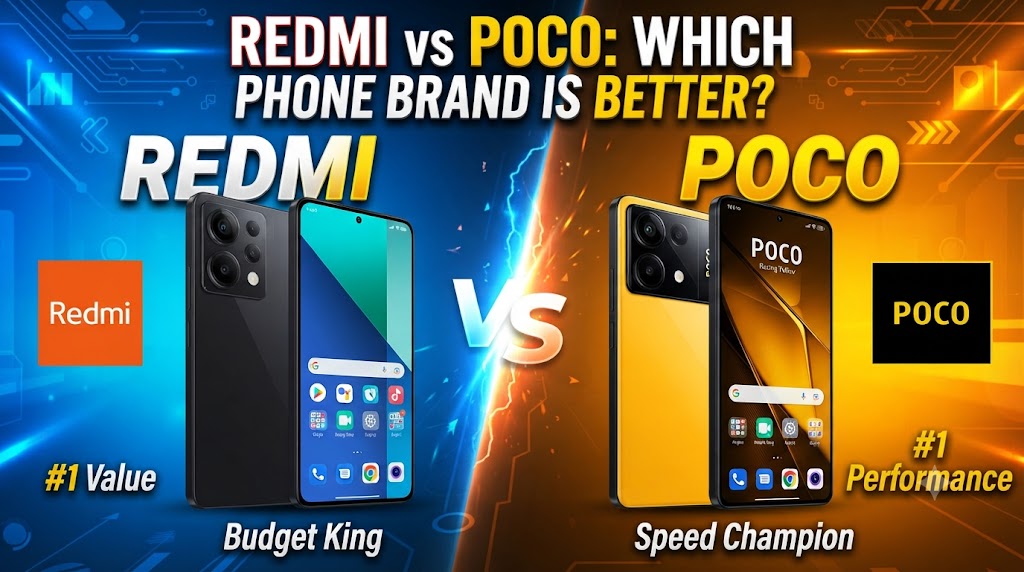
Redmi vs Poco
Choosing between two smartphone brands can be difficult when both offer attractive prices, capable processors, large batteries, and modern displays. Redmi vs Poco is a common comparison because both brands are known for offering feature-rich smartphones across budget and mid-range segments. However, they target somewhat different types of buyers, so the right choice depends on what you expect from your phone.
Redmi is Xiaomi’s long-established smartphone brand with a wide range of devices across different price categories. Poco, meanwhile, focuses strongly on performance, gaming, design, and value-oriented smartphones. Because both brands offer many models, comparing the exact phones is more useful than choosing a brand based only on reputation.
Quick Comparison: Redmi vs Poco
| Feature | Redmi | Poco |
|---|---|---|
| Main focus | Balanced features and broad choice | Performance and value |
| Budget options | Very broad | Broad |
| Performance | Good to high depending on model | Strong focus on performance |
| Gaming | Good on selected models | Major focus on selected models |
| Display | AMOLED and high-refresh options | AMOLED and high-refresh options |
| Battery | Large batteries on many models | Large batteries on many models |
| Charging | Fast charging on selected models | Fast charging on selected models |
| Cameras | Balanced camera options | Performance-focused, model dependent |
| Software | Xiaomi HyperOS | Xiaomi HyperOS |
| Best suited for | General smartphone users | Performance and gaming-focused buyers |
Specifications and features vary by individual model and market.
Redmi vs Poco: Performance
Performance is one of the most important parts of a Redmi vs Poco comparison.
Redmi offers smartphones with different processors depending on the model and price range. Its Note series, for example, includes phones designed to balance performance, cameras, display quality, and battery life.
Poco has traditionally placed greater emphasis on performance. Its F series is positioned toward high-performance users, while the X series also focuses on a combination of performance and other features.
Which is better for performance?
Poco has a strong performance-oriented approach, especially in its higher-end models.
Redmi also offers powerful smartphones, but its broader portfolio means that performance varies considerably from one model to another.
Practical meaning: If performance is your main priority, compare the processor, GPU, RAM, storage, cooling system, and sustained performance of the exact Redmi and Poco phones.
Redmi vs Poco: Gaming
Gaming is closely connected to performance.
Poco has built a strong identity around performance-focused smartphones. Higher-end Poco phones are designed to provide powerful processors, high-refresh-rate displays, and hardware intended for demanding games.
Redmi also offers gaming-capable smartphones, particularly in its higher-performing Note and premium models.
Which is better for gaming?
Poco may be particularly attractive to buyers who specifically want a performance-oriented phone for gaming.
However, Redmi can also provide good gaming performance when the selected model has a suitable processor and cooling system.
Practical meaning: Look beyond the brand. For gaming, compare the GPU, chipset, cooling, touch response, display refresh rate, battery, and sustained performance.
Redmi vs Poco: Display
Both brands offer phones with modern displays.
Redmi’s higher-end smartphones can include AMOLED panels, high refresh rates, high brightness, and other premium display features.
Poco also uses high-refresh-rate AMOLED displays on selected models, especially in its upper segments.
Which has the better display?
There is no universal answer.
A particular Poco phone may have a better display than a particular Redmi phone, while another Redmi model may offer a better panel than a Poco device.
Practical meaning: Compare brightness, resolution, refresh rate, HDR support, display size, panel technology, and screen protection.
Redmi vs Poco: Camera Quality
Camera performance is an area where the two brands can have different priorities.
Redmi generally provides balanced camera systems across many of its smartphones. Higher-end Redmi Note models can include high-resolution main cameras, optical image stabilization, ultra-wide cameras, and other photography features.
Poco also provides capable cameras, but some of its performance-focused phones place greater emphasis on processor and gaming hardware.
Which is better for cameras?
Redmi may be more suitable if camera performance is an important part of your buying decision and you are comparing similarly priced models.
However, this is not true for every model.
Practical meaning: Compare the actual camera hardware, sensor size, OIS, ultra-wide camera, telephoto capability, selfie camera, and video features.
Redmi vs Poco: Battery Life
Battery life is important for gaming, streaming, social media, and everyday use.
Both Redmi and Poco offer smartphones with large batteries.
Redmi uses high-capacity batteries across several models, while Poco also offers large batteries in many of its newer smartphones.
Which has better battery life?
Both brands can provide strong battery life.
The result depends on battery capacity, processor efficiency, display settings, software optimization, network conditions, and how heavily the phone is used.
Practical meaning: Do not judge battery life only by the mAh number. Look at the complete hardware and software combination.
Redmi vs Poco: Charging Speed
Fast charging is available on many Redmi and Poco phones.
The exact charging speed varies considerably by model and price range.
Poco often combines large batteries with fast charging, particularly in performance-focused phones. Redmi also offers fast-charging systems on selected Note and higher-end models.
Which is better for charging?
There is no universal brand-level winner.
If charging speed matters to you, compare the exact wattage and charging technology of the two phones.
Practical meaning: Also check whether the compatible charger is included in the box and whether charging speeds differ by region or model.
Redmi vs Poco: Software
Both Redmi and Poco smartphones use Xiaomi’s software ecosystem, with newer devices using Xiaomi HyperOS.
This means the basic software experience can have similarities between the two brands.
However, the interface, pre-installed applications, available features, and update schedules can vary depending on the individual phone.
Which software is better?
The difference is smaller than it may appear because both brands are part of the wider Xiaomi software ecosystem.
If software is important to you, check the exact HyperOS version, Android version, update policy, pre-installed apps, and available features on the phone you want.
Practical meaning: Don’t assume that every Redmi and Poco phone will receive identical updates simply because they use the same overall software platform.
Redmi vs Poco: Design and Build Quality
Design depends heavily on the individual model.
Redmi phones generally offer a wide variety of designs because the brand covers several price segments.
Poco often uses a more distinctive and performance-oriented design language, particularly on some of its gaming and high-performance phones.
Which has better design?
This is largely subjective.
Redmi can be suitable for buyers who prefer a more conventional smartphone design. Poco can appeal to users who like a more performance-oriented appearance.
Practical meaning: Compare weight, thickness, frame material, glass protection, camera design, IP rating, and ergonomics before buying.
Redmi vs Poco: Price and Value
Price is one of the main reasons people compare these brands.
Redmi has a very broad portfolio, giving buyers many choices across different budgets.
Poco also focuses strongly on value and performance, particularly in the budget-to-mid-range market.
Which offers better value?
Value depends on the exact models and their current prices.
A Poco phone may provide a powerful processor at a competitive price, while a Redmi phone at a similar price may put more emphasis on camera, display, design, or overall balance.
Practical meaning: Compare phones at the same price level and consider all their major specifications instead of looking only at the processor.
Redmi vs Poco: Which Has More Choices?
Redmi generally offers a broader selection of smartphones.
Its portfolio covers different budgets and user requirements, including entry-level phones, mainstream devices, Note series models, and higher-end options.
Poco has a more focused identity around performance and value, with product families aimed at different levels of the market.
Practical meaning: If you want many choices within a particular budget, Redmi’s wider portfolio can make comparison easier. If you specifically want performance-oriented hardware, Poco’s focused lineup can make the search more straightforward.
Redmi vs Poco: Which Is Better for Everyday Use?
For normal daily tasks such as WhatsApp, YouTube, browsing, social media, photography, video calls, and online payments, both brands offer suitable phones.
The important factors are:
- Processor
- RAM
- Storage
- Display
- Battery
- Camera
- Software
- Network support
- Update policy
Which should you choose for everyday use?
Redmi can be a good fit for users who want a balanced smartphone.
Poco can be suitable for users who want stronger performance and gaming capabilities without necessarily moving to a premium-priced phone.
Redmi vs Poco: Which Phone Brand Is Better?
The answer depends on your priorities.
Redmi may suit you if you prioritize:
- Balanced overall features
- More model choices
- Camera capabilities
- Display quality
- Everyday usability
- Different price options
Poco may suit you if you prioritize:
- Performance
- Gaming
- Powerful processors
- Fast performance at competitive prices
- Large batteries on selected models
- Performance-oriented design
These are general characteristics. Individual Redmi and Poco models can differ significantly.
Redmi vs Poco: Final Verdict
The Redmi vs Poco comparison does not have one universal answer.
Choose Redmi when you want a balanced smartphone with a broad range of models and features.
Consider Poco when your priority is performance, gaming, and powerful hardware at a competitive price.
Before buying, compare the exact Redmi and Poco models you are considering. Check the processor, GPU, camera, display, battery, charging speed, software support, storage, current price, warranty, and after-sales service.
Disclaimer
Smartphone prices, specifications, features, software versions, availability, and warranty terms may change over time and can vary by model, storage variant, country, retailer, and network. This article is intended for general comparison and buying research. Always check the manufacturer’s official specifications and current price before purchasing.